
Wednesday, June 15, 2011

Tuesday, June 07, 2011
Hypertension : High Blood Pressure
High Blood Pressure (Hypertension):
Symptoms, Causes and Treatments!!!
What Is Hypertension?
Hypertension, or high blood pressure, is a common condition that will catch up with most people who live into older age. Blood pressure is the force of blood pressing against the walls of your arteries. When it's too high, it raises the heart's workload and can cause serious damage to the arteries. Over time, uncontrolled high blood pressure increases the risk of heart disease, stroke, and kidney disease.
Hypertension Symptoms
High blood pressure is sometimes called a silent killer because it may have no outward symptoms for years. In fact, one in five people with the condition don't know they have it. Internally, it can quietly damage the heart, lungs, blood vessels, brain, and kidneys if left untreated. It's a major risk factor for strokes and heart attacks in the U.S.
What Causes Hypertension?
Normal blood pressure readings will fall below 120/80, while higher results over time can indicate hypertension. In most cases, the underlying cause of hypertension is unknown. The top number (systolic) shows the pressure when your heart beats. The lower number (diastolic) measures pressure at rest between heartbeats, when the heart refills with blood. Occasionally, kidney or adrenal gland disease can lead to hypertension
Prehypertension: A Warning Sign
Almost one-quarter of Americans have prehypertension. Their blood pressure is consistently just above the normal level -- falling anywhere between 120 and 139 for systolic pressure or 80 to 89 for the diastolic pressure. People in this range have twice the risk of developing heart disease than those with a lower reading. Your doctor may recommend lifestyle changes to help lower your blood pressure.
The Hypertension Danger Zone
You have high blood pressure if readings average140/90 or higher -- for either number -- though you may still have no symptoms. At 180/110 and higher, you may be having a hypertensive crisis. Rest for a few minutes and take your blood pressure again. If it is still very high, call 911. A hypertensive crisis can lead to a stroke, heart attack, kidney damage, or loss of consciousness. Symptoms of a hypertensive crisis can include a severe headache, anxiety, nosebleeds, and feeling short of breath.
Who Gets High Blood Pressure?
Up to the age of 45, more men have high blood pressure than women. It becomes more common for both men and women as they age, and more women have hypertension by the time they reach 65. You have a greater risk if a close family member has high blood pressure or if you are diabetic. About 60% of people with diabetes have high blood pressure.
Hypertension and Race
African-Americans are more likely to develop hypertension -- and to develop it at a younger age. Genetic research suggests that African-Americans seem to be more sensitive to salt. In people who have a gene that makes them salt-sensitive, just a half-teaspoon of salt can raise blood pressure by 5 mm Hg. Diet and excessive weight can play a role, as well.
Hypertension and Sodium
Sodium, a major component of salt, can raise blood pressure by causing the body to retain fluid, which leads to a greater burden on the heart. The American Heart Association recommends eating less than 1,500 milligrams of sodium per day. You'll need to check food labels and menus carefully. Processed foods contribute up to 75% of our sodium intake. Canned soups and lunch meats are prime suspects.
Hypertension and Stress
Stress can make your blood pressure spike, but there's no evidence that it causes high blood pressure as an ongoing condition. However, stress may affect risk factors for heart disease, so it may have an indirect connection to hypertension. Stress may lead to other unhealthy habits, such as a poor diet, alcohol use, or smoking, which can contribute to high blood pressure and heart disease.
Hypertension and Weight
Being overweight places a strain on your heart and increases your risk of high blood pressure. That is why diets to lower blood pressure are often also designed to control calories. They typically call for cutting fatty foods and added sugars, while increasing fruits, vegetables, lean protein, and fiber. Even losing 10 pounds can make a difference.
Hypertension and Alcohol
Drinking too much alcohol can increase your blood pressure. Guidelines from the American Heart Association state that if you drink alcohol, you should limit the amount to no more than two drinks a day for men, or one a day for women. They define a drink as one 12-ounce beer, four ounces of wine, 1.5 ounces of 80-proof spirits, or one ounce of 100-proof spirits.
Hypertension and Caffeine
If caffeine can make you jittery, can it also raise your blood pressure? It might have a temporary effect, but studies haven't shown any link between caffeine and the development of hypertension. You can safely drink one or two cups a day, according to the American Heart Association.
Hypertension and Pregnancy
Gestational hypertension is a kind of high blood pressure that occurs in the second half of pregnancy. Without treatment, it may lead to a serious condition called preeclampsia that endangers both the mother and baby. The condition can limit blood and oxygen flow to the baby and can affect the mother's kidneys and brain. After the baby is born, the mother's blood pressure usually returns to its normal level.
Hypertension and Medicine
Cold and flu medicines that contain decongestants are one of several classes of medicine that can cause your blood pressure to rise. Others include NSAID pain relievers, steroids, diet pills, birth control pills, and some antidepressants. If you have high blood pressure, talk to you doctor about what medicines and supplements you are taking that may affect blood pressure.
'White Coat' Hypertension
Some people only have a high reading in the doctor's office, perhaps because they're nervous. Some will only have blood pressure readings sporadically. Those people may have a higher chance of developing high blood pressure, a recent study shows. To get a more accurate reading, take your blood pressure at home, chart your readings, and share them with your doctor. It is also a good idea to bring in your home monitor in for a check of the device and your technique.
Hypertension and Children
While hypertension is more often a problem for older people, even children can have high blood pressure. "Normal" blood pressure varies based on a child's age, height, and sex, so your doctor will need to tell you if there is a concern. Children are at greater risk if they are overweight, have a family history of the illness and if they're African-American.
Treatment: The DASH Diet
You may be able to lower your blood pressure by switching to a better diet. The DASH Diet -- Dietary Approaches to Stop Hypertension -- involves eating more fruits, vegetables, whole-grain foods, low-fat dairy, fish, poultry, and nuts. You should eat less red meat, saturated fats, and sweets. Reducing sodium in your diet can also have a significant effect.
Treatment: Exercise
Regular exercise helps lower your blood pressure. Adults should get about 150 minutes of moderate-intensity exercise every week. That could include gardening, walking briskly, bicycling, or other aerobic exercise. Muscle-strengthening activities are recommended at least two days a week and should work all major muscle groups.
Treatment: Diuretics
Diuretics are often the first choice if diet and exercise changes aren't enough. Also called "water pills," they help the body shed excess sodium and water to lower blood pressure. That means you'll urinate more often. Some diuretics may deplete your body's potassium, causing muscle weakness, leg cramps, and fatigue. Some can increase blood sugar levels in diabetics. Erectile dysfunction is a less common side effect.
Treatment: Beta-blockers
Beta-blockers work by slowing the heart rate, which means that the heart doesn't have to work as hard. They are also used to treat other heart conditions, such as an abnormal heart rate called arrhythmia. They may be prescribed along with other medications. Side effects can include insomnia, dizziness, fatigue, cold hands and feet, and erectile dysfunction.
Treatment: ACE Inhibitors
ACE inhibitors reduce your body's supply of angiotensin II -- a substance that makes blood vessels contract and narrow. The result is more relaxed, open (dilated) arteries, as well as lower blood pressure and less effort for your heart. Side effects can include a dry cough, skin rash, or dizziness, and high levels of potassium. Women should not become pregnant while taking an ACE inhibitor.
Treatment: ARBs
Instead of reducing your body's supply of angiotensin II, these drugs block receptors for angiotensin -- as if placing a shield over a lock. This blockade prevents the chemical's artery-tightening effects, and lowers your blood pressure. ARBs can take several weeks to become fully effective. Possible side effects include dizziness, muscle cramps, insomnia, and high levels of potassium. Women should not become pregnant while taking this medication.
Treatment: Calcium Channel Blockers
Calcium channel blockers slow the movement of calcium into the cells of the heart and blood vessels. Since calcium causes stronger heart contractions, these medications ease the heart's contraction and relax the blood vessels. They can cause dizziness, heart palpitations, swelling of the ankles, and constipation. Take them with food or milk and avoid grapefruit juice and alcohol because of possible interactions.
Treatment: Other Medications
Other medications that relax the blood vessels include vasodilators, alpha blockers, and central agonists. Side effects can include dizziness, a fast heart beat or heart palpitations, headaches, or diarrhea. Your doctor may suggest them if other blood pressure medications are not working well enough or if you have another condition.
Treatment: Complementary Therapies
Meditation can put your body into a state of deep rest, which can lower your blood pressure. Yoga, tai chi, and deep breathing also help. These relaxation techniques should be combined with other lifestyle changes, such as diet and exercise. Be aware that herbal therapies may conflict with other medications you take, and some herbs actually raise blood pressure. Tell your doctor if you take herbal or other dietary supplements.
Living With High Blood Pressure
Hypertension is often a life-long condition. It's important to take your medications and continue to monitor your blood pressure. If you keep it under control, you can reduce your risk of stroke, heart disease, and kidney failure.
Tuesday, May 31, 2011
Anak Dagang Di Perantauan
Anak Dagang Di Perantauan
Permatang rimba bersuluh terang,
Ranting bersilang taut pegaga;
Dagang hamba jauh di seberang,
Membanting tulang buat keluarga.
Ke Kuala Sedili mencari kerang,
Kerang di bawa di dalam perahu;
Sungguh jauh di rantau orang,
Menangis di hati siapa yang tahu.
Masam manis buah kuini,
Jangan pula makan melampau;
Walau berkurun aku disini,
Tapi masih dipandang perantau.
Air diangkut di dalam timba,
Menyiram bunga tanam merata;
Usah diikut rasanya hiba,
Rindu tak terubat dek airmata.
Bayang redup si pohon kelapa,
Tempat berteduh si anak rusa;
Dagang tidak membawa apa,
Mengapa pergi menanggung dosa.
Naik sampan nak ke seberang,
Pergi bersama dengan di dara;
Hamba dagang di negeri orang,
Jauh dari sanak saudara.
Puas saya menanam ubi,
Nenas juga ditanam orang;
Puas sudah kutanam budi,
Emas juga dipandang orang.
Lebat pinang di pinggir Kampung,
Masak setangkai letak di peti;
Sedih hati mengenang untung,
Jauh merantau mencari rezeki.
Anak puyuh patah lah kaki,
Memagut selasih dipinggir kali;
Susah payah dagang mencari rezeki,
Rahmat kasih Allah luas sekali.
Girangnya hati sang teruna,
Bertemu dara di hujung bendang;
Apalah ada pada hamba,
Rupa tiada harta pun kurang.
Burung ketitir membuat sarang,
Sarang dibuat dirumah tamu;
Hamba ini seorang pedagang,
Dagang untuk mencari ilmu.
Baik-baik meniti bendang,
Tanah yang lecak licin sekali;
Rupa tiada harta pun kurang,
Hanya ilmu penyuluh diri.
Burung terbang diatas perigi,
Sampan kolek penuh kelapa;
Mencari ilmu di tempat tinggi,
Namun asal ku tidak ku lupa.
Buah delima tingalnya satu,
Tempat bersarang semut dan kerengga;
Sunguh pun jauh beribu batu,
Namun yang tercinta dikenang juga.
Daun gelenggang pengubat santau,
Pohonnya condong tumbuh berjejeran;
Anak dagang asing di rantau,
Jangan lupakan desa kelahiran.
Silau persada berjejal bintang,
Indah purnama di Kuala Rusa;
Kalau tiada aral melintang,
Pulanglah jua hamba ke desa.
Sumber: melayu.com
Pantun Dagang Melarat
Apa digulai orang di ladang,
Pucuk kacang sela-bersela;
Apakah untung anak dagang,
Hari petang tangga berhela.
Orang Padang mandi ke gurun,
Mandi berlumur bunga lada;
Hari petang matahari turun,
Dagang berurai air mata.
Banyak kajang perkara kajang,
Kajang saya mengkuang layu;
Banyak dagang perkara dagang,
Dagang saya terbuang lalu.
Tanjung Katung jauh ke laut,
Nampak dari Belakang Mati;
Terapung-apung di tengah laut,
Dipukul ombak jatuh ke tepi.
Kain songket panjang sembilan,
Panjang serta kepalanya;
Tuan umpama pertama intan,
Saya menumpang akan cahayanya.
Permatang rimba bersuluh terang,
Ranting bersilang taut pegaga;
Dagang hamba jauh di seberang,
Membanting tulang buat keluarga.
Ke Kuala Sedili mencari kerang,
Kerang di bawa di dalam perahu;
Sungguh jauh di rantau orang,
Menangis di hati siapa yang tahu.
Masam manis buah kuini,
Jangan pula makan melampau;
Walau berkurun aku disini,
Tapi masih dipandang perantau.
Air diangkut di dalam timba,
Menyiram bunga tanam merata;
Usah diikut rasanya hiba,
Rindu tak terubat dek airmata.
Bayang redup si pohon kelapa,
Tempat berteduh si anak rusa;
Dagang tidak membawa apa,
Mengapa pergi menanggung dosa.
Naik sampan nak ke seberang,
Pergi bersama dengan di dara;
Hamba dagang di negeri orang,
Jauh dari sanak saudara.
Puas saya menanam ubi,
Nenas juga ditanam orang;
Puas sudah kutanam budi,
Emas juga dipandang orang.
Lebat pinang di pinggir Kampung,
Masak setangkai letak di peti;
Sedih hati mengenang untung,
Jauh merantau mencari rezeki.
Anak puyuh patah lah kaki,
Memagut selasih dipinggir kali;
Susah payah dagang mencari rezeki,
Rahmat kasih Allah luas sekali.
Girangnya hati sang teruna,
Bertemu dara di hujung bendang;
Apalah ada pada hamba,
Rupa tiada harta pun kurang.
Burung ketitir membuat sarang,
Sarang dibuat dirumah tamu;
Hamba ini seorang pedagang,
Dagang untuk mencari ilmu.
Baik-baik meniti bendang,
Tanah yang lecak licin sekali;
Rupa tiada harta pun kurang,
Hanya ilmu penyuluh diri.
Burung terbang diatas perigi,
Sampan kolek penuh kelapa;
Mencari ilmu di tempat tinggi,
Namun asal ku tidak ku lupa.
Buah delima tingalnya satu,
Tempat bersarang semut dan kerengga;
Sunguh pun jauh beribu batu,
Namun yang tercinta dikenang juga.
Daun gelenggang pengubat santau,
Pohonnya condong tumbuh berjejeran;
Anak dagang asing di rantau,
Jangan lupakan desa kelahiran.
Silau persada berjejal bintang,
Indah purnama di Kuala Rusa;
Kalau tiada aral melintang,
Pulanglah jua hamba ke desa.
Sumber: melayu.com
Pantun Dagang Melarat
Apa digulai orang di ladang,
Pucuk kacang sela-bersela;
Apakah untung anak dagang,
Hari petang tangga berhela.
Orang Padang mandi ke gurun,
Mandi berlumur bunga lada;
Hari petang matahari turun,
Dagang berurai air mata.
Banyak kajang perkara kajang,
Kajang saya mengkuang layu;
Banyak dagang perkara dagang,
Dagang saya terbuang lalu.
Tanjung Katung jauh ke laut,
Nampak dari Belakang Mati;
Terapung-apung di tengah laut,
Dipukul ombak jatuh ke tepi.
Kain songket panjang sembilan,
Panjang serta kepalanya;
Tuan umpama pertama intan,
Saya menumpang akan cahayanya.
HISTORY OF MALAYA FLAG (LATER MALAYSIA IN 20TH CENTURY)
Malaya Flag Proposals 1947-1949 (Malaysia)
People's Flag, 1947
![[Malaysia 1947 people's flag]](http://www.fotw.net/images/m/my-rakyat47.gif)
image by Hairul Hisham, 6 June 2008
The People's Flag was officially used all over Malaya since 10 Dec 1947. According to Utusan Melayu newspaper, almost all big towns and small towns including Malacca, Johor Bahru, Kuantan, Sungai Siput, Alor Stra and Singapore had a flag ceremony.
The meaning of the symbol on the People's Flag is:
12 stars - 12 states in Malaya, i.e., 9 Malay states + 3 Straits Settlements (Perak, Selangor, Negeri Sembilan, Pahang, Terengganu, Perlis, Kelantan, Kedah, Johor + Pulau Pinang, Melaka, Singapura).
Yellow Color on Star - People's justice and sovereignty, constitution approved, imagine all states in peace and prosperity.
Five sided on the star - God, people's sovereignty, social justice, welfare, nationhood.
Red color - The peoples' bravery and power for the challenge; facing all obstacles; resistance in order to create justice and democracy in Malaya
White color - Struggle based on honesty and purity to obtain true freedom without any greed and bribery, but only with one ambition, i.e., our own government based on People's Sovereignty
Also: the red-white color represents Malaya's peoples and was chosen by PUETRA and AMCJA (both after Japanese Occupation resistance) because it is the Malay national flag color since Majapahit on 14th century (Same as the Indonesia flag.)
Adapted from : 10tahun.blogspot.com
Hairul Hisham, 6 June 2008
Flag Proposals 1949
Document, BT 11/4189, in the Public Record Office at Kew explains some of the thinking behind the design of the Malaysian Flag.Federation of Malaya Order No.61 of 1949 announced that a committee had been set up to make recommendations for the design of a Federation Flag. A competition was organised with the suggestion that, in any design submitted, the flag should be simple, and have not more than four colours, which might perhaps be yellow, red, white and blue, the colours most frequently used in the flags of the nine states and two settlements of the federation. Suitable symbols would include the kris (a Malayan sword), tiger, and crescent.
A total of 373 entries were received. The committee chose three to put before the Legislative Council:
![[Malaysia 1949 proposal]](http://www.fotw.net/images/m/my!1949a.gif)
image by Eugene Ipavec, 7 September 2007
In the centre of a blue flag, two crossed red kris, surrounded by a circle of eleven white five pointed stars. (Crossed kris can be seen behind the anchor on the Malaysian naval ensign).Explanation. Colours; red was found on six state/settlement flags, white on five, and blue on three, and all were colours of the Union Jack. Eleven stars of equal size, equally spaced, represented the states/settlements in no particular order, and each of equal importance. Kris was of great antiquity and peculiar to the Malayan archipelago, thus identifying the flag with Malaya.
![[Malaysia 1949 proposal]](http://www.fotw.net/images/m/my!1949b.gif)
Similar to the first proposal, but with the stars arranged in two concentric circles, one of six stars, outside one of five stars.
Explanation. The same as first proposal, with the inner circle of stars representing the Unfederated Malay States and the outer circle the four Federated States and two Settlements.
![[Malaysia 1949 proposal]](http://www.fotw.net/images/m/my!1949c.gif)
Six blue and five white horizontal stripes. A red canton half the length of the flag resting on top of the white stripe second from the bottom. A yellow five point star, oriented with one point in the six o'clock position, in the centre of the canton, and a yellow crescent, arranged like a C, between the star and the hoist.
Explanation. One stripe for each state or settlement. Yellow star and crescent represented sultanate monarchies of the states, and the religion of the states. The red field of the canton represented British protection and the complete red, white, blue associated the Federation with the Commonwealth.
![[Malaysia 1949 proposal]](http://www.fotw.net/images/m/my!1949d.gif)
Same as the third proposal, but with crossed kris instead of the crescent and star.
The newspaper Malay Mail published the designs and organised a poll. 42 percent favoured the third proposal, 27 percent wanted the fourth, with kris instead of the crescent and star, and 25 percent wanted a Union Jackincluded.
On 6 March 1950 the Federal Legislative Council decided that none of the designs were acceptable, and asked for a revised design that would be considered on 19 April. At this meeting the Council approved a revised version of (3) in which, the blue stripes were replaced by red stripes, the red canton was replaced by a blue canton, and the five point star was replaced by an eleven point star.
According to I.O. Evans writing in 1953 [eva57];
Its colours combine the traditional royal hue, gold, of the Sultans of Malaya with the red, white and blue of Britain; the eleven stripes and points on the star indicate that number of states in the Federation; the crescent and star form the traditional Mohammedan emblem.The company producing the first batch of flags questioned the width of the canton, which was 7 stripes deep, when it could be 6 stripes deep and still more than half the width of the flag. The answer was that the stripes represented the unity of the states and settlements, and it was hoped that Singapore would join the Federation when an additional white stripe would be added to the bottom of the flag.
David Prothero, 2 May 2002
![[Federation of Malaya 1950-1963 (Malaysia)]](http://www.fotw.net/images/m/my1950.gif)
Description
In 1950 a new flag was introduced: the basic design is that preserved in the modern flag, but 11 stripes and an 11-pointed star, representing the number of constituent states. In 1963 three more states (Sabah, Sarawak, and Singapore) joined the federation and country's name changed to Malaysia. The common explanation for the addition of the 's' in the name is that all three new states start with this letter. The number of stripes on the flag was increased to 14 as was the numbers of points on the star.The flag of Malaysia is a combination of traditional Islamic symbols and the Stars and Stripes. The 14 stripes and the 14 points of the star represents the 14 member states and the crescent and star represents the dominant religion Islam. The blue canton stands for affiliation to the Commonwealth. The dimension of the flag is 1:2.
Jan Oskar Engene, 24 June 1996
The old Malayan (for the Federation of Malaya) flag was similar to the present day Malaysian flag except that the star and the stripes were 11 for the 11 states of Peninsular (or West) Malaysia. The flag was changed with the creation of Malaysia in 1963.
Thomas W. Koh, 14 May 1997
[Translated from the Malaysian flags official URL:]
History of the FlagThe flag was chosen by a body established in 1949 to choose a flag for the Federation of Malaya. A competition was held by the Federal Legislative Assembly, in which 373 entries were submitted of which 3 made it to the final stage. The first design was a badge of crossed kris circled with 11 five-pointed stars. The second design was similar to the first, except that the 11 stars were arranged in two circles around the crossed kris. The third design was 11 blue and white stripes with a yellow moon and star at the hoist.
The Malay Mail surveyed public opinion, and on 28/11/49 published the result, i.e. a majority for the third design, the creation of a government architect from Johore, En. Mohd b. Hamzah.
With a few amendments the flag attained the support of the Council of Rulers on 22/2/50 and on 19/4/50 the Federal LegCo passed a motion That in the opinion of this Council the Flag of the Federation of Malaya should be as follows:- Eleven horizontal stripes alternately red and white in colour, the uppermost stripe being red, having a blue quarter with a crescent and eleven-pointed star in yellow superimposed, the standard size of the flag to be six feet by three feet.
The design was approved by HM King George VI on 19/5/50, and the flag was first flown at a flag-raising ceremony held by the British High Commisisoner on 26/5/50 in the compound of the Sultan of Selangor's palace, attended by TH the Rulers of the Malay States and British officials.
Andrew Yong, 15 August 1999
Flag used at the 1950 British Empire Games
![[Flag used at the 1950 British Empire Games (Federation of Malaya 1950-1963, Malaysia)]](http://www.fotw.net/images/m/my1950_g.gif)
by António Martins and Dean Thomas
The flag shown here is a Union Flag defaced with the word 'MALAYA'. This flag was used by the Malaya team at the 1950 British Empire Games in Auckland, New Zealand.
Dean Thomas, 15 August 1999
Malaysia
![[Malaysia]](http://www.fotw.net/images/m/my.gif)
 image by Clay Moss, 6 January 2006
Flag adopted 16th September 1963
Description
I came across an official Malaysian Year Book in my local library and it had 'official' descriptions of the Malaysian national and state flags as well as description of armorial ensigns, state emblems and other information like state anthems, history, rulers (as in 'sultans') etc.The Malaysian National Flag consists of fourteen red and white stripes (along the fly) of equal width, a union or canton of dark blue, a crescent and a star. The red and white stripes stand for equal status in the federation of the member states and the federal government. The union or canton of dark blue represents the unity of the peoples of Malaysia. The union contains the crescent which is the symbol of Islam, and the star, the 14 points of which symbolise the unity of the 13 states of the federation with the federal government. The yellow of the crescent and the star is the royal colour of the Rulers.Thomas W. Koh, 14 May 1997
The 14 stripes on the Malaysian flag represent the 14 states of Malaysia (Perlis, Kedah, Perak, Kelantan, Terengganu, Pahang, Johor, Malacca, Negri Sembilan, Selangor, Penang, Sabah, Sarawak and the Federal Territories of Kuala Lumpur and Labuan). The blue square represents the harmony of the people. The crescent symbolises Islam, the national religion and the colour yellow is the colour of royalty.
Giuseppe Bottasini, 13 August 1997
[Translated from the Malaysian flags official URL:]
The dark blue stands for the unity of the Malaysian people. The crescent moon is a symbol of the official religion Islam. The 14 pointed star symbolises the unity of the 13 states and the federal government. The yellow is the colour of Their Highnesses the Rulers of the Malay States.The rules for flying flags seem to be the same as in the UK, etc, except that in Malaysia state flags are flown in the honour position at state events and on state holidays. Also, the order of state flags is according to the precedence of their Rulers, which is according to seniority, sultans/rajas then governors.
Andrew Yong, 15 August 1999Regarding the origin of the flag, I may not have the exact citation but growing up in Malaysia, the sporadic pieces of information on the origin of our national flag has seeped into our psyche. Here are some well know facts that may help explain why the uncanny resemblance to the Stars and Stripes:
- Malaysia is a federation of previously independent states (not autonomous)
- We are one of a handful states in the work that is constituted based on a federation model (like India, Australia, Canada, US)
- Therefore, our founding fathers drew their inspiration from a handful of existing models at that time:
o India has no element of "unity of elements" in its flag
o Australia and Canada (old flag, pre '64) is too British with the Union Jack in it
o The US was the post war hero, liberators and role model to the world on many fronts with a great federalist flag.
- Each stripe represents one of the states (grew from 11 to 14)
- The star has 14 pointed tips The symbol of equality and strength in unity is reflected in its design.
Origins of the Flag
Smith 1980 [smi80] says, "Blue was chosen for the Malaysian flag to show its association with the Commonwealth (...)". Pedersen 1971 [ped71] is more specific, "Dark blue is from the British flag and symbolizes the connexion with the Commonwealth". I noticed that two recent books, Dorling-Kindersley 1997 [udk97] and Znamierowski 1999 [zna99], have dropped the connection with the Commonwealth. I would not be surprised if the change in the 'meaning' of the blue colour were associated with the accession of Mahathir Muhamad to the power in July 1981. Mahathir has developed a nationalistic ideology and would like to be the 'champion' of South-East Asia. This could explain that the reference to the British Commonwealth was discarded.Ivan Sache, 23 April 2002
Document, BT 11/4189, in the Public Record Office at Kew explains some of the thinking behind the design of the Malaysian Flag. Federation of Malaya Order No.61 of 1949 announced that a committee had been set up to make recommendations for the design of a Federation Flag. (...)
David Prothero, 2 May 2002
The colour blue on the flag may have represented the Commonwealth originally, but this is not the case now. Blue symbolises unity or perpaduan in Malay.
Nagathisen Katahenggam, 25 August 2002
Malaysia is a federation of monarchies and a member of the (British) Commonwealth. The use of red and white stripes to represent a federation is clearly a United States innovation, but early U.S. flag designers probably got the idea of red and white stripes from the flag of the British East India Company, whose ships were frequently seen in American ports. The Straits Settlements were an East India Company protectorate, and I suspect that the stripes on the Malaysian flag make reference to both their federation and their history with the East India Company.
Jonathan Makepeace, 15 January 2003
The derivation of the US flag from the East India Company flag is widely posited but also disputed. It is, as I understand it, not true that East India Company ships were frequently seen in American ports, at least not flying the 'gridiron' flag. Also, the Straits Settlements did fall under the East India Company, but not after the company was dissolved in 1858, 105 years before the Malaysian flag was adopted. Absent any legislative history supporting this theory, it seems to me less persuasive than the hypothetical connection to the Stars and Stripes.
Joseph McMillan, 15 January 2003
The very construction of the Malaysian flag, with its much larger blue canton [cf. the Johore war ensign], is virtually a denial of US influence. Whether the red-and-white stripes in the Malaysian flag can be derived from theEast India Company is a moot point, but the popularity of red and white in the East Indies (Malaysia and Indonesia [cf. for instance the Indonesian jack]) predates any influence on the part of either Britain or the United States. Red and white are part of the traditional colours of the Malagasy people, too, remember — a people whose origins are in Borneo.
Mike Oettle, 19 January 2003
The founding fathers of Malaysia definitely had no reason to imitate the US flag. To find out the reason for the design of Malaysian flags, we have to check on the political history of Malaysia at the time of the independence. Malaysian politics till today comprises three distinct political parties each representing the 3 ethnic races of Malaysia - Malays, Chinese and Indians:
UMNO: United Malay National Organisation -represent the Malays
MCA: Malaysian Chinese Association-represent the Chinese
MIC: Malaysian Indian Congress -represent the Indians
The flags of the MCA is blue field with a yellow sun. The MIC flag is red and white stripe with MIC in Tamil and English at the centre. Now merge these two flags - the MCA flag on the canton and the MIC flags without the blue stripes on the fly. The crescent moon on the canton represent Islam hence the Malays.
Nadarajan V, 1 June 2009
At a Penang state track and field meet was last week I met an elderly gentleman (Mr. Ibrihim). He introduced himself and then began to ask questions about me...and after a while, he pointed to a Malaysian flag and asked me if the flag made me feel "at home" in any way. He then said that he was asking the question from a flag similarity standpoint. Surprisingly, he then said; "We intentionally copied the American flag you know." I said; "Really? How so?"
He said that in those days, there was a good deal of positive sentiment about the US and that the newly independent Malaya wanted to mimic the US form of government in as many ways as possible. They wanted to draft a constitution that was similar to that of the US and they were hopeful that they would develop as a nation as successfully as America had. Additionally, he said that the Malay were grateful for US intervention during WW II while also quietly encouraging the British to "let go" after the war ended. He said that the US flag serving as inspiration for the design of Malaya's flag was a natural sort of process and simply seemed like "the way to go." I was amazed that I was getting to listen to Mr. Ibrihim's story and asked him how he knew all of this. He then let me know that he had been a Malay state representative from Penang during and right after independence came along.
About that time, I had to excuse myself and said that I would return in a few minutes. When I got back to my seat, Mr. Ibrihim was gone. I never got to probe further relative to his story. I hope to track Mr. Ibrihim down soon.
Clay Moss, 11 April 2010
Name of the Flag: Jalur Gemilang
The Flag Bulletin [tfb], #186, March-April 1999, page 74, says under the heading "Flag News and Notes" [smi99e]:Malaysia: The government of Prime Minister Datuk Seri Dr. Mahathir Mohamad has introduced many changes into the economic, political and social systems of Malaysia. On the 40th anniversary of the country's independence, 31 August 1997, provision was made for an official name for the national flag. The version chosen, Jalur Gemilang, combines a Malay word meaning "stripes" or "range of values" with the adjective ("gemilang") signifying "glorious". No change was introduced in the design of the flag.
Santiago Dotor, 20 December 1999
Vertical hanging of the flag
![[Malaysia - vertical flag]](http://www.fotw.net/images/m/my_vert.gif)
A vertical, swallow-tailed Malaysian flag was shown in a TV documentary. I don't know how official it is, but it was hanging outside the Petronas Towers--a position of that visibility may mean something.
Eugene Ipavec, 14 July 2005
2:3 variant
![[Malaysia - 2:3 variant]](http://www.fotw.net/images/m/my-23.gif)
Broad Bottom Stripe
Sometimes seen is a typical Malysian national flag, except that the bottom white stripe wis abnormally wide, perhaps twice as wide as the others, maybe a bit less.Jorge Candeias, 20 June 2009
There are lots of those type Malaysian flags flying here and there. They are printed cotton broad cloth and come in all sizes. Whoever makes/made them will simply get their screens a bit too narrow for whatever width they are trying to print. Usually the manufacturer is working with a piece of material that is pre-woven with tapered locked edges. That way, the flags do not have to be hemmed on the top or bottom. So, all they do is print, hem the fly and hoist and sell.
Clay Moss, 21 June 2009
Flags in Malaysia
Malaysia is really a good place for flag spotting. Flags are almost all over the place and not only the Malaysian flag but also all 14 states flags. People put little flags on their cars or inside their cars, they also use stickers with Malaysian flag and inscription 'Proud to be Malaysian' and so on. If you visit Kuala Lumpur you must go to the Merdeka Square and see one of the tallest flag poles in the world (100 metres). The Union Jack was lowered at midnight on August 30, 1957 and the Malayan flag hoisted up for the first time. It is really magnificent. There are Malaysian and Federal Territory flags in front of the court building and all 14 states flags under the huge pole. The flag is really big and it's really great when you see it from different parts of the city. Here is a little picture of the Merdeka Square with the tall flag pole.Uros Zizmund, 25 July 1999
I found this flag related news in the East Malaysian Daily Express online version 13 April 2001:
Kota Kinabalu: Fifty-eight students from Universiti Putra Malaysia (UPM) 10th College and Kolej Ibukota Kinabalu (KIK) fought coldness and fatigue to unveil Malaysia's largest Jalur Gemilang (national flag) on the summit of Mt Kinabalu last week. On Thursday, they once again unveiled the 118m x 77m flag at the KIK main campus football field in an attempt to enter the Malaysia Book of Records.Organised by the UPM 10th College undergraduate supreme council in collaboration with KIK, as the main sponsor, the project cost some RM20,000 and it took the students four months to prepare the flag. (...)Strange dimensions, 118m x 77m, giving a proportion of (almost exactly) 13:20, as opposed to the official ratio of 1:2. Santiago Dotor, 16 April 2001
KERIS MORO
|
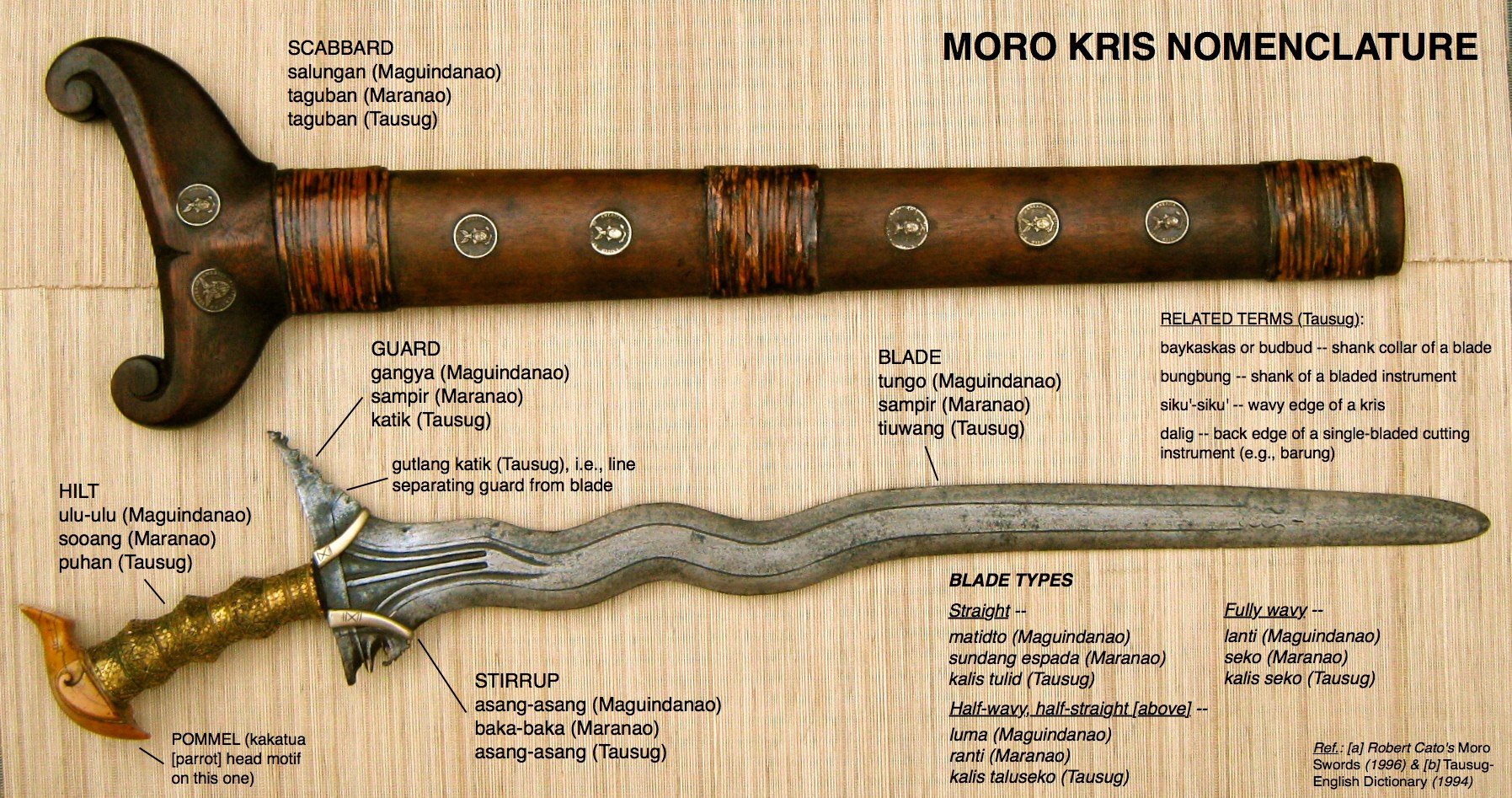


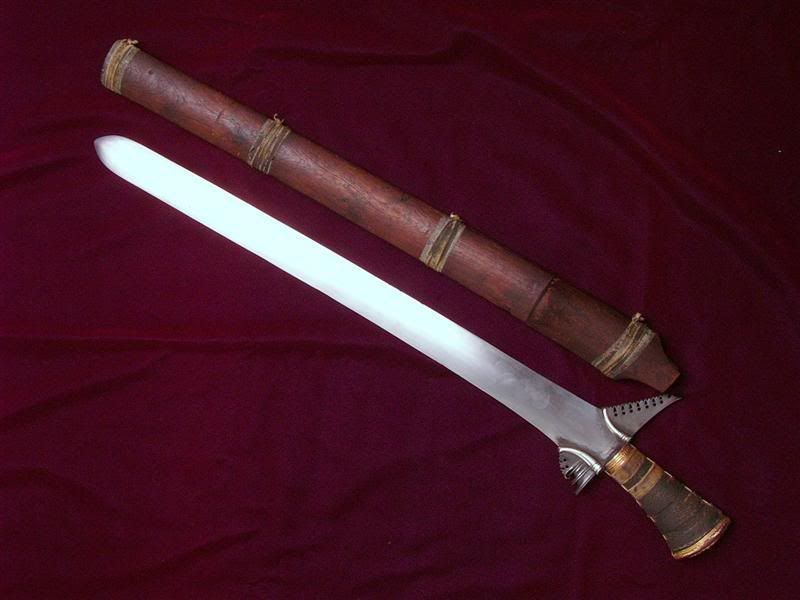
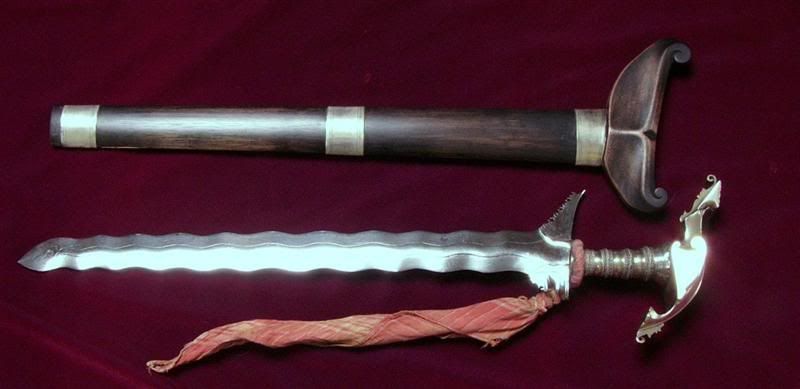
Here are more pics of various antique Kris from another forum I frequent:
Quote:
|
![[image]](https://lh3.googleusercontent.com/blogger_img_proxy/AEn0k_uxeRUuBXVINaimTMYTYsyrWzEEvt-maqBzp77HjPrSLRun2I4nh-8A54dGwzM8iJKNaDstU-3E--oqaGc4SCgF4h3qdDcnb5Lkc9Qq765_bmeXYiC3BiiD-Ewm3Iub=s0-d "[image]")
![[image]](https://lh3.googleusercontent.com/blogger_img_proxy/AEn0k_sd9Y_PS6jw2-vjkBK2u2oAvZmsl60ZGqnqdpKupUvOOHFnOMeMzbNEPwTpj_qbRZVrq1NVddinYkFIYa-LalZobXVyyogmP3gAev6_k4Xaq4eUeNO8tinF1UAwku8Q=s0-d "[image]")
![[image]](https://lh3.googleusercontent.com/blogger_img_proxy/AEn0k_ssdqGQ3VZKumhFdbKKd72WM_nSnhJKMPpiSTnjZdYY5_MqnfJgqvIlHm74f7_OBQdcPbl4mjMzM8u06bK6G2cOOB_ljd6yuL8x7goOdMl0n-8mKCOk4ItYD_7IqiG2=s0-d "[image]")
![[image]](https://lh3.googleusercontent.com/blogger_img_proxy/AEn0k_u8ZRaCcZESvoHukK81wLDrhRqRAAq7B08uM0508VVEjCZeAaSBPhQ4HqSSX9qcaIH3O_u3CifO5ISO8g6LJaiAFWe1Z7FQfrh8YBikms6mLITciuBMi32N0NSdnhdS=s0-d "[image]")
Quote:
|
![[image]](https://lh3.googleusercontent.com/blogger_img_proxy/AEn0k_tQsSNMGWS5lwyDYFBIAr6wCaVCxmhyauXfgLeq7fsIH5eaCNn4gdltKAb1uHVJHr6JX_tAXV9_3wFINWomvoWGlpcvWJQIgw92BG32CZp_iVoK7A_FzOb1kearS4cp=s0-d "[image]")
![[image]](https://lh3.googleusercontent.com/blogger_img_proxy/AEn0k_sK_T_wav8NnquZytS1bgkfXV6pwzDlLSZKPH5GRzP7Eb6IoVw55D8XYXuvcTh_BB9Y40cWoeoMczrrUOK_qNltJ0_tZljE9BrVt5njgucHahfvu-2qJR6duwsf74gn=s0-d "[image]")
![[image]](https://lh3.googleusercontent.com/blogger_img_proxy/AEn0k_sz3l0w2_rPMh3xJgjkrHyudFBuvMdgMsHfOjuSiVgpnAcfpJqYgzKQ3DhF81-TJeGqKBQU1jQl3UG6lAoTKGXopCoHZgPBBCH7RYp4_VtI1sq-h7m2uuQHRd8UeRA=s0-d "[image]")
Quote:
|
![[image]](https://lh3.googleusercontent.com/blogger_img_proxy/AEn0k_s2FAFBYv2CDDcjjS5SQ3nsJAChPj-QW5sKsspXSzzimo4ZEvC_22c6KrwnNlbi1aIj4B_X936mkGzLTfBB0-l9s_Stj6W78Kupu1qs-gR145OfsY6MUmY75_TPDixEWkJeGP-4p5FCpLUXikEYdOClrrBKH8a1bQ=s0-d "[image]")
![[image]](https://lh3.googleusercontent.com/blogger_img_proxy/AEn0k_t8KqBjnoOJfLSXX_px1yy8yu0Ns0Y7n3KwQVjIrt_tHsm7K5gHNU61aJbAmH8fqyvr24VS5n8U4e2izZEfSKA1uhap1jOVlVFdfa9Nrx0Hvh7_XjzCpEF9l0eTm53zUkGpzPOse47Kxmv0GTgp6xvV7elo447x=s0-d "[image]")
![[image]](https://lh3.googleusercontent.com/blogger_img_proxy/AEn0k_vXXVS7hrQKKFZMhkvDCkEtw98ZyU2lxJD0XDpSjKfdnr23Wd2cW8Cti2fV0vQYtBOgtNl1Pfa4ZiJtVoeWBwA-DU0MtCMQr3EOtuHK3-JVuGMOpVr4GVG0uDMujoI-rjw5bL0f-wiXlfxnUN9qHXICxC9t9usJ8g=s0-d "[image]")
![[image]](https://lh3.googleusercontent.com/blogger_img_proxy/AEn0k_t62Tw_xcu2bhrxRgtnWlHSImxQGqEC0eakc7BRS2V1FXniuULuHFBSP4TInIXpHR69Ng5qGWPOgIKtlqTnbBnavNz-lPm8IXLteVVTf3iDyey9YDj4r4IyOIO48W8s65BZjM9Da_cc456wAqzUMYC3ZzmlUdmVdu4=s0-d "[image]")
![[image]](https://lh3.googleusercontent.com/blogger_img_proxy/AEn0k_sT9hZ7mypewKW-D5vllsU1YYct8PkEUok0tjnf9JHBwKQUo19T3OtVZd5bzvadITLLB6UqTQE_K6cRSbAEGuuwxnpsSLfMAumYXCHGeLZBLDcIsPFJlCclMBcViYK3Boqtv7jWvN3evp71ARupKShxO9ZCgmRK=s0-d "[image]")
![[image]](https://lh3.googleusercontent.com/blogger_img_proxy/AEn0k_ulxqFy6REeR7zRK70o4iec4PJK1iE6vgkzBXj9kS4yLkkpxWO5hhpTJhiRRIZjWWF9mvmnGTWuambiUVBPIAR44N639kIqqYIgw5WXSFqoZbMN7--GdN0ikba_0J_ah16Y44KyR4PdOG1uNRL1XPMsTejPb3BW=s0-d "[image]")
Quote:
|
![[image]](https://lh3.googleusercontent.com/blogger_img_proxy/AEn0k_tqsHE8csvDy8gfgZUblYf4xYXX1xXag5FBI7l-6OSzeKP6B1UJz0Dk0DYSPnhBVHQNsUgmNZbs-zypuRAAuAtvHFBu7F_8OuvFMPHH-gWY9JYPlxx3aAyKEZI5aM6mUwE-LDtK218ybXd3xjPp4alGge7tMps4Qa4hmJ4=s0-d "[image]")
![[image]](https://lh3.googleusercontent.com/blogger_img_proxy/AEn0k_v6kGbyUPGzShR5blIi9cP1ILmUhMzFezldxRfmDc6mnjV7D4j7FvobcI6Bq1AzbjDjom88dGXhV_xTep4Jd54dXMdu49Jm_KisvxSH0E22tqsMh5ud4AkZXOP-VzR_7EP5q7jgPU8VyHQFrNtUm1Yh5qJdusqpfKFDjA=s0-d "[image]")
Quote:
|
![[image]](https://lh3.googleusercontent.com/blogger_img_proxy/AEn0k_sbiq2Z83yEwixUGXquIZU4YWiQSD7hQIFDiPKim74HBlzXXIJaxTi-QSZuFojeXIClTw1WJ6tsixlep17SZicjv-WkJs5YCzGf8eCJQ6_i2H44RhfhK8lrRNo4QtfgL1KA3nkcSKWHJ9limdU0-k6x2jlDIJYG1Oz_RfbEGQ4=s0-d "[image]")
![[image]](https://lh3.googleusercontent.com/blogger_img_proxy/AEn0k_sH-EZmPLoEWqreh0xb6EF5p8Juf8Pst51sAe1PfKU4PKQ1AgQHPTuw4D36d1ad0OTQANXWDY73a-ZHRu3yybB-Iz-nvMNgexlGZk5JunQQABnSxZlqd7Ivdiyq-ug75vz8vehT3ILDUM-WTNw66zEXEFBpxQWIm6dToNAPl_Q=s0-d "[image]")
![[image]](https://lh3.googleusercontent.com/blogger_img_proxy/AEn0k_twzfIwgSyR85PeyNoYeIOKHr2hptK1Bh3PXBhFBJFVcNFTUCDVT69YGAfc3TIJUKsUVq-UdWzc1SyoNeQV5E1aFRdlopRfqkoZfX1v52z5aWI5kW4yWf7st2XCHIUatOIxzagFXWuzPAiAmcu_hIaIxWadstwyz2uGRMMULg=s0-d "[image]")

Subscribe to:
Posts (Atom)
Raja-Raja Melayu Diselamatkan
Peristiwa Sejarah Bagaimana Orang-orang Melayu Menyelamatkan Raja Mereka. Hari ini kita belajar sejarah. Supaya rakyat Malaysia dan teruta...

-
 Ustaz Ali Haji Ahmad , meninggal dunia siang tadi.. Isnin 23 Mac 2013. Ulamak besar Kedah.. Guru ku yang amat dikasihi, yang menegur sal...
 -
Apakah GCR (Gantian Cuti Rehat) APAKAH GANTIAN CUTI REHAT? Gantian Cuti rehat adalah Award wang tunai yang ...